What Are Coffee Tasting Notes? Coffee tasting notes are the descriptive flavors and aromas that roasters and coffee professionals identify in a particular bean. They are not added flavors but natural expressions of the coffee’s chemical composition, origin, processing method, and roasting profile. Understanding these notes transforms your daily cup from a simple caffeine fix into a rich sensory experience.
If you have ever stared at a coffee bag reading “blueberry, dark chocolate, and jasmine” and wondered whether those flavors were actually inside the beans, you are not alone. Many coffee lovers ask exactly what are coffee tasting notes and whether they are real or simply marketing language. This guide will break down everything you need to know about coffee tasting notes, from the science behind them to practical techniques for identifying them in your own cup.
What Are Coffee Tasting Notes?
Coffee tasting notes—also called flavor notes or cupping notes—are a taster’s written description of the aroma, taste, and character of a specific coffee. These notes serve as a roadmap, guiding your palate toward flavors you might enjoy and away from those you might not.
When you ask what are coffee tasting notes from a technical perspective, the answer lies in chemistry. Contrary to popular belief, tasting notes are not added flavors. When a roaster writes “caramel” or “citrus” on a bag, they are describing chemical compounds naturally present in the coffee that mirror flavors found in those foods. For example, the compound ethyl-3-methylbutanoate, also found in blueberries, can create a blueberry-like sensation in certain Ethiopian coffees.
The Difference Between Taste, Aroma, and Flavor
To truly understand what are coffee tasting notes, you must distinguish between three core concepts:
- Taste: The sensations detected by your tongue—sweetness, sourness, bitterness, saltiness, and savoriness.
- Aroma: The smells perceived through your nose (orthonasal) and the back of your mouth (retronasal). Aroma dominates what we perceive as flavor.
- Flavor: The combination of both taste and aroma. This is what roasters describe when they list tasting notes.
Are Tasting Notes Added to Coffee?
No. Specialty coffee never contains added flavoring unless explicitly labeled as “flavored coffee.” The tasting notes on a bag of single-origin Ethiopian Yirgacheffe reflect the bean’s natural chemistry, shaped by its terroir, variety, processing, and roast profile. If you are asking what are coffee tasting notes because you suspect artificial additives, rest assured that authentic specialty coffee relies entirely on natural compounds.
What Are Coffee Tasting Notes Chemically?
Coffee is one of the most chemically complex beverages humans consume. With over 1,200 volatile compounds contributing to its flavor, aroma, and body, coffee surpasses even wine in chemical complexity. Every stage of a coffee bean’s life cycle adds or unlocks these compounds, which is why professionals spend years learning how to answer what are coffee tasting notes with precision.
The Chemistry of Coffee Flavor
Coffee flavor comes from its vast arrangement of chemical compounds. Many of these molecules are also present in fruits, flowers, and spices. When you drink coffee containing these compounds, your brain recognizes them and evokes familiar flavors. This scientific reality is the foundation of what are coffee tasting notes in professional cupping.
For instance:
- Citrus notes often come from organic acids like citric and malic acid.
- Chocolate notes develop from Maillard reaction products during roasting.
- Floral notes are linked to volatile aromatic compounds similar to those in jasmine or rose.
- Berry notes frequently originate from esters and aldehydes shared with actual fruits.
From Seed to Cup: Factors That Influence Flavor
Table
| Factor | Impact on Tasting Notes |
|---|---|
| Origin / Terroir | Altitude, soil minerals, and climate create the bean’s foundational flavor profile. High-altitude coffees often exhibit brighter acidity and complex fruit notes. |
| Variety | Arabica sub-varieties like Geisha, Bourbon, and Typica each carry distinct genetic flavor potentials. Learn more about single origin vs blend. |
| Processing | Washed (wet) processing highlights acidity and clarity. Natural (dry) processing enhances fruitiness and body. Honey processing balances both. |
| Roasting | Light roasts preserve origin character and acidity. Medium roasts develop balance and sweetness. Dark roasts emphasize body, bitterness, and roasted flavors. Read our guide to coffee bean roast levels explained. |
| Brewing | Extraction time, temperature, and grind size determine which compounds are pulled into your cup. Your method directly impacts what are coffee tasting notes you actually perceive. |
How to Read Coffee Tasting Notes on Packaging
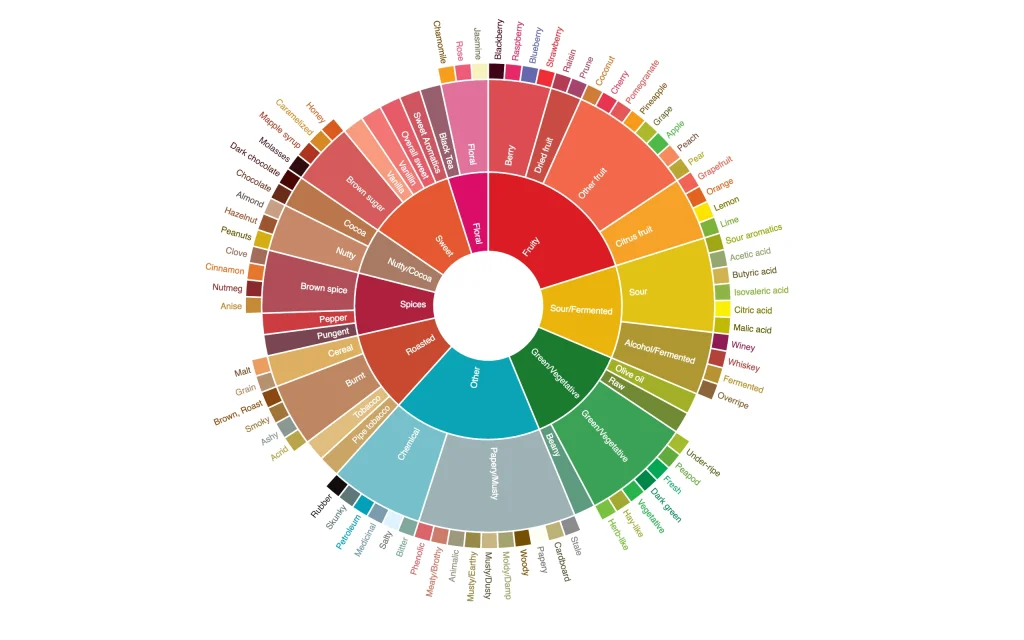
Reading tasting notes is a skill. Roasters use the SCA Coffee Taster’s Flavor Wheel as a standardized reference to describe what they detect during professional cupping sessions. When you see notes listed on a bag, they typically follow this priority:
- Primary note: The most dominant flavor (e.g., “blueberry”).
- Secondary note: A supporting flavor that adds complexity (e.g., “dark chocolate”).
- Tertiary note: A subtle nuance or finish (e.g., “bergamot”).
Pro tip: Tasting notes are subjective guides, not guarantees. Your palate may detect different flavors based on your personal flavor vocabulary and brewing method. If you wonder what are coffee tasting notes on a specific bag, remember they represent the roaster’s professional interpretation.
The SCA Coffee Taster’s Flavor Wheel Explained
The Specialty Coffee Association (SCA) Coffee Taster’s Flavor Wheel is the industry’s most iconic sensory tool. Originally published in 1995 and updated in 2016 in collaboration with World Coffee Research, it provides a shared language for describing coffee. The SCA Flavor Wheel is essential for anyone asking what are coffee tasting notes in a professional context.
[IMMAGINE 1: Inserisci qui l’infografica SCA Flavor Wheel]
- Alt Text: What Are Coffee Tasting Notes – SCA Coffee Flavor Wheel showing flavor categories from fruity to nutty
- Caption: What Are Coffee Tasting Notes? The SCA Flavor Wheel provides a standardized language for describing coffee flavors.
How to Use the Flavor Wheel
The wheel is designed to work from the inside out:
- Start at the center with broad categories like “fruity,” “nutty,” or “floral.”
- Move to the middle ring for subcategories (e.g., “berry” or “citrus”).
- Reach the outer ring for specific descriptors (e.g., “strawberry” or “grapefruit”).
Main Flavor Categories on the Wheel
The SCA Flavor Wheel organizes coffee flavors into major families:
- Sweet / Sugary (honey, caramel, molasses)
- Fruity (berry, citrus, dried fruit, stone fruit)
- Floral (jasmine, rose, chamomile)
- Nutty / Cocoa (almond, peanut, dark chocolate)
- Spices (clove, cinnamon, pepper)
- Roasted (tobacco, smoky, burnt)
- Green / Vegetative (olive, raw potato, hay-like)
Common Coffee Tasting Notes by Category
Use this table as a quick reference guide when shopping for coffee or describing what you taste. Understanding these categories helps answer what are coffee tasting notes in practical daily terms.
Table
| Category | Common Notes | Typical Origins |
|---|---|---|
| Fruity | Blueberry, strawberry, lemon, peach, mango | Ethiopia, Kenya, Colombia |
| Floral | Jasmine, rose, orange blossom, lavender | Ethiopia, Panama (Geisha), Rwanda |
| Nutty / Cocoa | Almond, hazelnut, peanut, dark chocolate, milk chocolate | Brazil, Colombia, Guatemala |
| Sweet | Caramel, honey, brown sugar, vanilla | Costa Rica, El Salvador, Nicaragua |
| Spicy | Cinnamon, clove, nutmeg, black pepper | Indonesia, India, Yemen |
| Earthy | Tobacco, cedar, leather, wet soil | Sumatra, Sulawesi, India |
What Are Coffee Tasting Notes by Region?
Coffee origin is one of the strongest predictors of flavor. While microclimates and processing create variation, these regional profiles provide a useful starting point for understanding what are coffee tasting notes in different parts of the world.
African Coffees
African coffees, particularly from Ethiopia and Kenya, are celebrated for their bright acidity and complex fruit flavors. Ethiopian naturals often burst with blueberry and strawberry notes, while Kenyan washed coffees deliver blackcurrant and tomato-like savory acidity. If you want to explore these profiles, check out our guide to the best Ethiopian coffee beans.
Latin American Coffees
Central and South American coffees typically offer balance and sweetness. Colombian coffees are known for caramel and nutty profiles. Brazilian beans often provide chocolate and peanut notes with lower acidity. Costa Rican honey-processed coffees shine with stone fruit and brown sugar sweetness.
Asia-Pacific Coffees
Indonesian coffees like those from Sumatra and Sulawesi are famous for their full body and earthy, herbal notes. You will often find tobacco, cedar, and dark chocolate in these cups. Papua New Guinea coffees can offer cleaner profiles with tropical fruit notes.
How to Identify Coffee Tasting Notes Like a Professional
You do not need to be a Q Grader to taste coffee like a professional. With practice and the right technique, anyone can develop their sensory skills. Here is exactly how professionals answer what are coffee tasting notes in a specific cup.
Step 1: Observe the Aroma
Before tasting, inhale deeply. Smell the ground coffee (fragrance) and the brewed coffee (aroma). Look for initial impressions: is it floral, fruity, nutty, or earthy? Professionals often use the SCA Flavor Wheel as a guide during this step.
Step 2: Slurp and Spread
Take a small, loud slurp. This aerates the coffee and sprays it across your entire palate, allowing aromas to travel to your olfactory receptors. This is essential for detecting complexity.
Step 3: Identify Flavor Notes
Ask yourself: what does this remind me of? Start broad (fruity vs. nutty) and then narrow down (citrus vs. berry). Reference the Flavor Wheel if you get stuck. This is the core of what are coffee tasting notes in practice.
Step 4: Evaluate Body and Acidity
- Body: How does the coffee feel in your mouth? Heavy and creamy like whole milk (full-bodied), or light and tea-like?
- Acidity: Is it bright and lively like a lemon (high acidity), or soft and round like an apple (mild acidity)?
Step 5: Notice the Aftertaste
Swallow and pay attention to what remains. A high-quality coffee leaves a clean, pleasant finish. A lower-quality coffee may leave harshness or astringency.
What Are Coffee Tasting Notes During Professional Cupping?
Cupping is the professional standard for tasting. To try it at home, follow the coffee cupping protocol established by the Specialty Coffee Association:
- Grind coffee to a coarse consistency.
- Add 8–10 grams to a small bowl.
- Pour hot water (200°F / 93°C) over the grounds.
- Wait 4 minutes, then break the crust with a spoon and inhale the aroma.
- Skim the grounds and slurp the coffee to taste.
Why Can’t I Taste the Notes on the Bag?
If you cannot taste “blueberry” in your blueberry-noted coffee, do not worry. Tasting notes are guides, not guarantees. Several factors affect your ability to detect specific flavors. If you ask what are coffee tasting notes but cannot detect them, your brewing method may be the culprit.
Building Your Flavor Vocabulary
Taste is deeply personal and depends on your memory of flavors. If you have never eaten lychee or marzipan, those tasting notes will not resonate with you. Build your vocabulary by tasting different fruits, chocolates, and spices intentionally.
The Role of Brewing Method
The same bean can taste radically different depending on how you brew it. A pour-over might highlight floral and citrus notes, while an espresso extraction could emphasize chocolate and caramel. French press often enhances body and earthy tones. Learn how to brew pour over coffee to maximize delicate notes.
Coffee Tasting Notes vs Added Flavors
A common point of confusion is the difference between natural tasting notes and artificially flavored coffee. When asking what are coffee tasting notes, it is crucial to understand this distinction:
- Natural tasting notes: Descriptors of compounds inherently present in the bean. These change with origin, processing, and roast.
- Added flavors: Oils or syrups infused into beans after roasting. These are labeled explicitly as “French Vanilla” or “Hazelnut” flavored coffee.
Specialty coffee focuses exclusively on natural notes. If a bag says “Blueberry” without mentioning added flavoring, it refers to natural aromatic compounds.
How to Build Your Personal Flavor Library
To truly master what are coffee tasting notes, you need a personal reference bank. Here is how to build one:
- Buy diverse single origins: Purchase beans from Africa, Latin America, and Asia-Pacific.
- Cup them side by side: Brewing multiple coffees simultaneously highlights differences.
- Keep a tasting journal: Write down what you smell and taste for each coffee.
- Reference the Flavor Wheel: Use the SCA tool to name what you experience.
- Slurp intentionally: The louder, the better for aroma detection.
Frequently Asked Questions About Coffee Tasting Notes
What are coffee tasting notes?
Coffee tasting notes are real sensory descriptors based on the coffee’s natural chemical compounds. They are not marketing fiction. However, they are subjective interpretations, and different tasters may describe the same coffee differently.
Do tasting notes mean flavor was added to the coffee?
No. In specialty coffee, tasting notes describe naturally occurring flavors. Only coffees explicitly labeled “flavored” contain added flavoring oils or syrups.
What is the best way to learn coffee tasting notes?
To truly learn what are coffee tasting notes, practice with the SCA Flavor Wheel, taste coffees from different origins side by side, and keep a tasting journal. Slurping and mindful tasting will accelerate your learning.
Why does the same coffee taste different at home versus at a café?
Brewing variables—water temperature, grind size, extraction time, and water quality—all impact flavor. Baristas also calibrate equipment precisely, which can highlight different notes than a home setup.
Can two people taste completely different notes in the same coffee?
Yes. Taste is subjective and influenced by your personal flavor memories, genetics, and even mood. This is why the coffee industry uses standardized tools like the Flavor Wheel to create a common language.
What are the most common coffee tasting notes for beginners to identify?
Beginners often find it easiest to start with broad categories: chocolate, nut, caramel, citrus, and berry. These are common across many coffees and provide a foundation for more nuanced detection.
What are coffee tasting notes for espresso versus filter coffee?
Espresso typically amplifies body, sweetness, and roasted notes like chocolate and caramel due to pressure extraction. Filter methods like pour-over highlight acidity, clarity, and delicate floral or fruity notes.
Are expensive coffees more likely to have complex tasting notes?
Generally yes. Higher-priced coffees often come from prized micro-lots, rare varieties like Geisha, or meticulous processing methods that preserve and enhance complex aromatic compounds.
Conclusion
What Are Coffee Tasting Notes? They are the language of coffee—a bridge between the chemistry in your cup and the sensory experiences in your memory. By understanding where these flavors come from, how to read them on packaging, and how to identify them through mindful tasting, you can dramatically enhance your coffee appreciation.
Now you know what are coffee tasting notes, where they come from, and how to identify them. Start with the SCA Flavor Wheel, explore single-origin coffees from different regions, and practice the professional slurp. Over time, you will develop a personal flavor vocabulary that makes every cup more rewarding.
Ready to taste coffee like a pro? Grab a bag with tasting notes that intrigue you, brew it carefully, and see what you discover.